

Most owners of local service businesses have heard the phrase "topical authority" and come away thinking it is a score Google hands out if you publish enough blog posts. It is not. For a local business, topical authority is best understood as a content-planning idea: you build strong, focused service pages, surround them with content that answers real customer questions, and connect those pages with useful links. Google has not published a topical-authority metric for ordinary business websites, and its similarly named "topic authority" system applies to news queries and publishers, not your plumbing company or physiotherapy clinic.
So this article shows you the method behind a topical authority map. We will walk through how to plan content that supports your service pages, using one trade as a worked example, and point out the honest limits of what content can and cannot do.
Who this article is for and who it is not for
This article is for owners and managers of Canadian local businesses with 1 to 50 staff who want to plan content in a way that supports the services they actually sell. It is written with four groups in mind: home services (plumbing, electrical, roofing, cleaning, lawn care, moving), health and wellness practices (psychologists, physiotherapists, chiropractors, dentists, optometrists), professional services (accountants, bookkeepers, lawyers, real estate agents, mortgage brokers), and personal care and fitness (hair salons, spas, gyms, yoga studios).
It is probably not for you if:
- You run a large national brand or an e-commerce store with no local service area.
- You want a trick to jump to the top of Google this month.
- You are looking for a fixed number of blog posts to publish and then stop thinking about it.
If you fall into the second or third group, the planning method here will feel slower and more deliberate than you want, because it is built around decisions a real customer makes before and after hiring you.
What does topical authority mean for a local business?
For a local business, topical authority means your website has a clear focus, each service you want enquiries for has its own strong page, and your supporting content answers the questions customers really ask about those services. It is a planning framework, not a dial you can watch in a dashboard.
Here is a useful way to hold the idea:
- Your website has a clear business and subject focus.
- Each commercially important service has a strong, distinct page.
- Supporting content answers real questions that come up before, during and after buying that service.
- Pages are connected through useful contextual links.
- Your claims show first-hand experience, legitimate credentials and local operating knowledge.
And here is what it is not:
- A score Google shows you in Search Console.
- Something you achieve by publishing a set number of articles.
- A reason to write about every keyword even loosely related to your trade.
- A replacement for your Google Business Profile, reviews, links or technical SEO.
- A guarantee of Maps, organic or AI-search rankings.
Google's guidance suggests thinking about whether a site has a primary purpose, an intended audience, and content that shows first-hand expertise, and it points toward helpful information created for people. You can read the current wording on Google on creating helpful content. The practical takeaway: a pile of thin articles will not rescue a weak service page, and one strong article will not lift every other page on your site. Ranking mostly happens at the page level.
Why does this matter for Canadian local businesses?
This matters because search is a mainstream way Canadians find local services, and your own website is still a trust asset. That is a good reason to plan content properly rather than treat it as an afterthought.

A credible website supports how your business looks when a prospective customer checks you out, while content strengthens how relevant you appear for a search. It cannot shrink the distance between you and a searcher. Local visibility also depends on your Google Business Profile, reviews and links. We cover how Google's local ranking actually works in our guide to how Google decides which businesses to show.
How do you plan a topical authority map? A worked example
The method is to put your service pages at the centre, then build supporting content around the real decisions a customer makes. Let us map one trade so you can see the shape, then you can copy the pattern for yours.

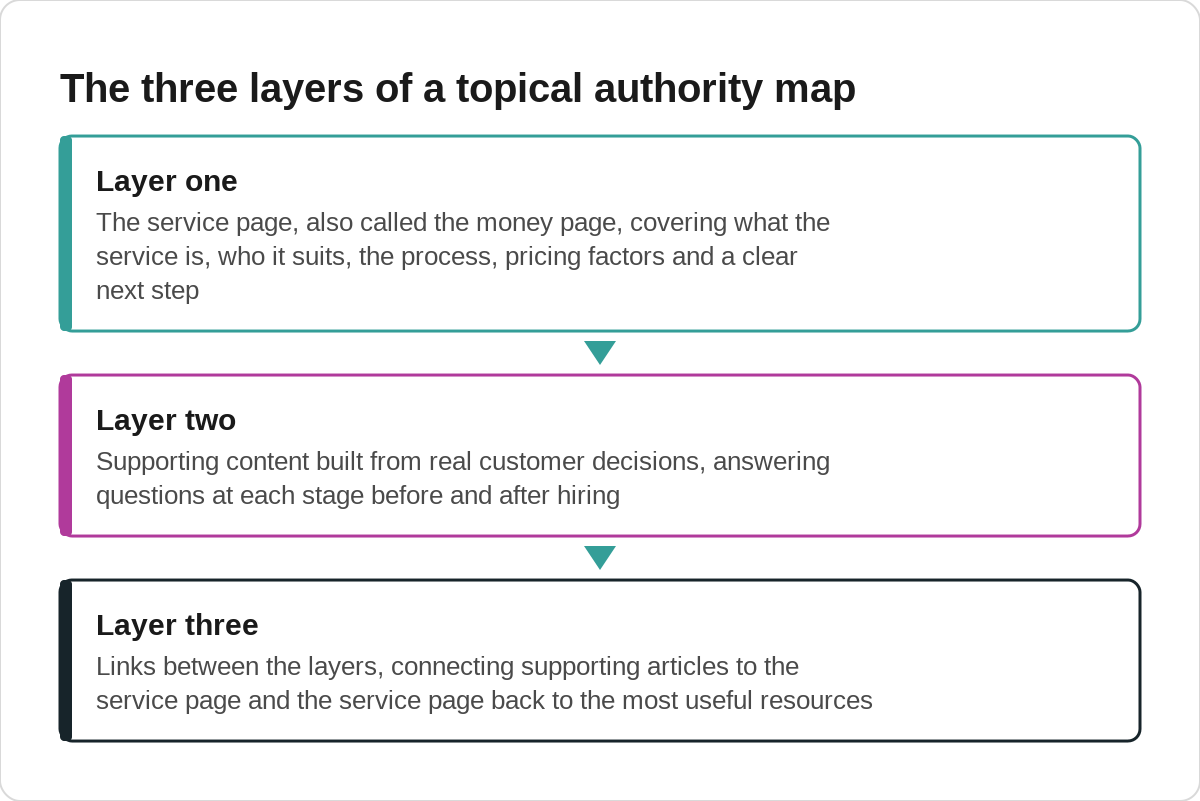
Take a residential drain cleaning service at a plumbing company. The map has three layers.
Layer 1: the service page (the money page)
This is the commercial foundation. A useful drain cleaning service page should normally cover:
- What the service is and the problem it solves.
- Who it is and is not appropriate for.
- Your service area or physical location.
- The process and what the customer should expect.
- Timing, availability, and price or the factors that affect price.
- Relevant licences, insurance or professional oversight.
- First-hand proof: original project photos, staff commentary or verifiable examples.
- Common objections and questions.
- A clear next step, such as call or request a quote.
A good practice is to use unique, clear titles that describe the page. Repeating "drain cleaning Toronto" over and over is keyword stuffing, not topical relevance.
Layer 2: supporting content built from customer decisions
Each supporting article resolves one question that would be awkward to cram onto the service page. Here is the drain cleaning cluster, mapped by decision stage:
| Decision stage | Supporting article example |
|---|---|
| Problem recognition | "Signs your drain is blocked and not just slow" |
| Service selection | "Drain cleaning vs. hydro jetting: which one you need" |
| Cost and scope | "What affects the cost of drain cleaning" |
| Preparation | "What to clear before a plumber arrives" |
| Local conditions | "Calgary freeze-thaw risks for outdoor drains" |
Notice that none of these compete with the service page for its own search terms. Each one answers a research question, then hands the reader to the service page when hiring becomes the logical next step.
Layer 3: the links between them
This is where many maps fall apart. Connect the pieces on purpose:
- Link each supporting article to the service page at the point where professional help is the obvious next step.
- Link the service page to the one or two resources that help a visitor evaluate or prepare.
- Use concise, descriptive anchor text such as "emergency drain-cleaning service", not "click here".
- Do not link every article to every service.
A sound habit is to make sure every page that matters is linked from another page, and to keep anchor text descriptive and relevant. Internal links do real work. As we did for one of our trade clients recently, we added 71 links from their own pages to the services that were sitting on page two to five of Google.
How do you choose which content to create?
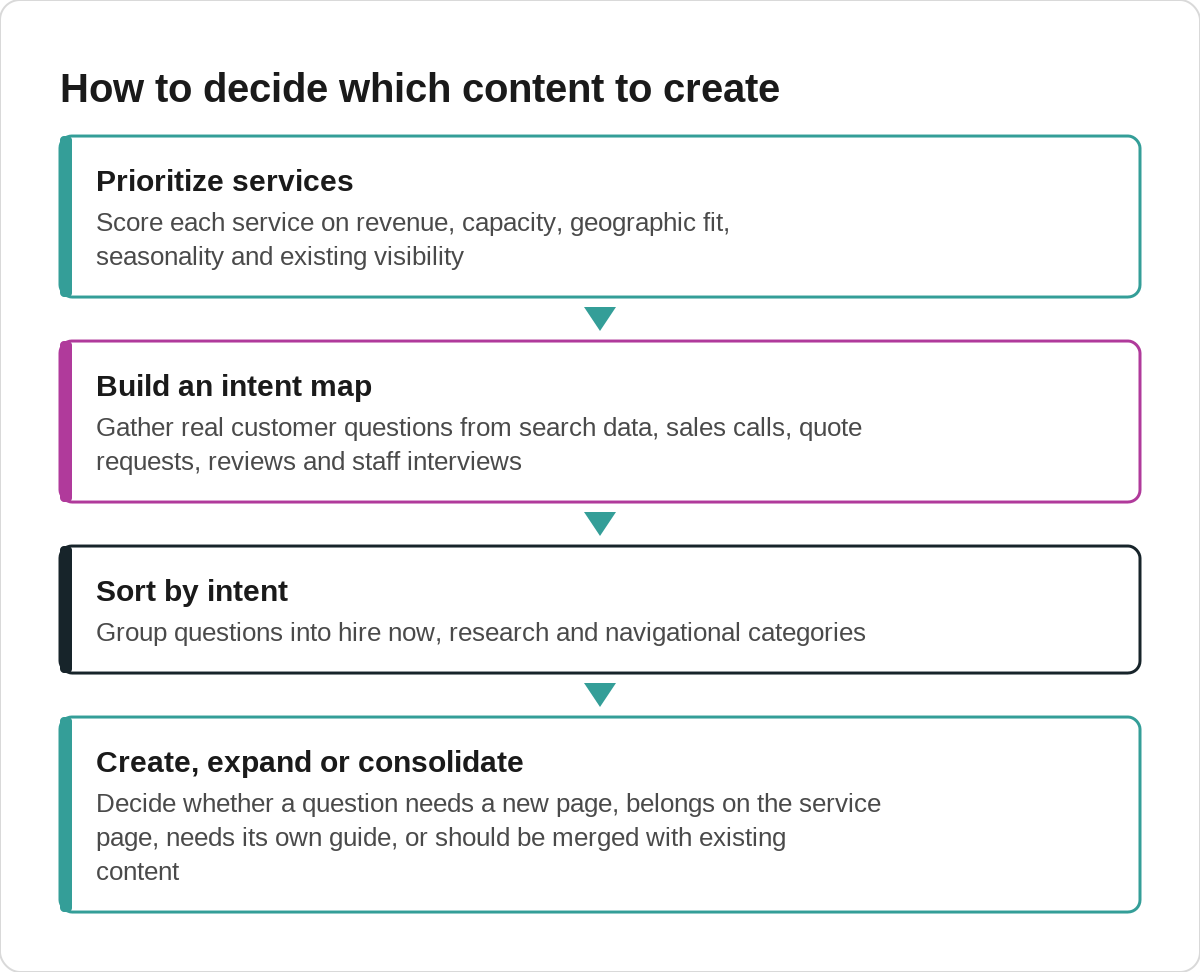
Choose content by scoring your services first, then mapping the questions around each one. Start with the business, not the blog.

Here is a simple process you can follow.
- Prioritize services. Score each one on revenue or margin, capacity to take more work, geographic fit, seasonality and existing visibility. Start with a few high-priority services, not an arbitrary weekly schedule.
- Build one intent map per service. Pull questions and wording from Search Console, your Google Business Profile search terms, recorded sales and reception questions, quote requests, reviews and staff interviews. Pulling that wording together is the heart of our keyword research services.
- Sort the questions by intent. Hire-now questions belong on the service page. Research questions often deserve a supporting guide. Navigational questions (hours, location, contact) belong on their own pages.
- Decide: create, expand or consolidate. Create a service page for distinct commercial intent. Expand a service page when the question is essential to deciding whether to hire. Create a supporting article when a question needs a full explanation. Consolidate when several pages answer the same thing. Do not publish when the subject is unrelated or offers nothing original.
This works the same way across all four groups. An accounting firm might prioritize year-end filing, then write "bookkeeper vs. accountant for an Ontario small business". A physiotherapy clinic might prioritize initial assessments, then write "how to prepare for your first physiotherapy appointment". A hair salon might prioritize balayage, then write "how long balayage takes and how to maintain it".
What about AI search and AI Overviews?
AI search rewards the same thing: clear, first-hand, useful answers to real questions. It does not reward mass-produced pages.
Google's guidance indicates that its AI features draw on its core ranking and quality systems, so there is no special AI-only optimization to chase, and it suggests that things like AI text files, Markdown copies or special schema are not used by Google Search. A site may also need to be included in the Search Console generative AI setting, which Google describes as on by default. AI search is part of the SEO work, not a separate product with its own price.
So the opportunity is not a flood of generated pages targeting every possible phrasing. It is well-scoped supporting content that genuinely answers a complex local-service question better than a thin, generic page could.
Common mistakes to avoid
The most common mistakes come from treating content as a volume game. Here is what to watch for.
- Thin city pages. Cloning "plumber in Toronto" into dozens of near-identical pages that funnel to the same place is doorway abuse by Google's definition. A location page should exist only when it has real local value: genuine availability, local staff or contact details, original photos, or municipal and climate considerations.
- Mistaking length for depth. There is no useful universal word count. Depth means covering the decision properly, not padding every page to 2,000 words.
- Treating FAQs as a search trick. On-page FAQs are still useful for answering objections. Google stopped showing FAQ rich results in Search in May 2026, so do not write them expecting an expanded result.
- Overstating schema. LocalBusiness structured data can share facts like your business type, address, phone and hours, but it must match what visitors can see on the page, and it does not create authority on its own. As we did for one of our clients recently, we copied every FAQ answer into the schema word for word from the page, and rebuilt it whenever the page text changed, because Google expects structured data to match what visitors can see on the page.
What do regulated professions need to check?
Regulated professions need a profession-specific approval step before publishing, because advertising rules vary by province, profession and sometimes the channel. These are not uniform across Canada.
If you run a health practice, law firm, accounting firm, real estate business, mortgage brokerage or insurance brokerage, your College or regulator sets what you may and may not say in advertising. Testimonials, specialist claims and outcome statements are often restricted, and the exact rules depend on your province and licence. Always confirm the current rules from your own regulator before you publish.
Across all of Canada, the federal Competition Act prohibits materially false or misleading representations in online advertising, social posts, promotional email and endorsements. Performance claims need proper testing done before you make the claim, and testimonials alone are not adequate proof. A good habit is to record the author, any professional reviewer, the source consulted, the approval date and the next review date for each piece.
How do you measure whether the content is working?
Measure by service cluster, not by individual blog post, and watch business outcomes rather than just rankings. A supporting guide can help the main service page even when the guide itself brings in few direct enquiries.
| Level | What to watch |
|---|---|
| Coverage | Priority services with complete pages, questions answered, orphan pages |
| Search visibility | Search Console impressions, clicks, position by service cluster |
| Local visibility | Google Business Profile searches, calls, website clicks, direction requests |
| Business outcomes | Qualified calls, forms, bookings, quoted and accepted jobs |
Keep your Google Business Profile accurate while you do this, since it carries much of your local visibility. Our page on Google Business Profile management explains that side of the work.
On timing, set a realistic internal expectation. Google's own guidance suggests some changes can appear within hours while others take months, and it advises waiting a while before judging a single change. You can see this in the Google SEO Starter Guide. We plan on 6 to 12 months as our own planning horizon for meaningful SEO results, which is a planning horizon and not a promise. No one can honestly guarantee a number-one ranking.
Your topical authority planning checklist
Use this checklist to turn the method into action.
- List your services and score them by revenue, capacity and strategic fit.
- Pick your top few priority services to start.
- Build one strong, distinct page for each priority service.
- Map real customer questions for each service from Search Console, reviews and staff.
- Sort questions into hire-now, research, navigational and post-purchase intent.
- Decide whether to create, expand or consolidate each page.
- Add first-hand proof: photos, staff input, local knowledge, clear cost factors.
- Link supporting content to the right service page with descriptive anchors.
- Run a truthfulness review, and a regulator check if you are a regulated profession.
- Report by service cluster over a 6 to 12 month horizon.
If you want the broader picture of how this fits with the rest of your local SEO, our plain-language guide to SEO for small businesses in Canada is a good next read.
Planning a full topical authority map, researching the questions and writing the pages takes time most owners do not have. If you would rather have a documented plan built around the services you actually want to sell, you can learn how we approach it on our content strategy page or through our content marketing services, or book a call with our team to talk it through.