

When a customer in Calgary needs an electrician or a leak fixed in Vancouver, they usually pull out their phone and search. SEO, which stands for search engine optimization, is simply the work of making your business easy for search engines to understand and easy for customers to trust and contact. For a Canadian home service company, it comes down to three connected parts: showing up in Google Maps, showing up in the regular website results, and turning that visibility into real calls and booked jobs. You can do some of it yourself. Some of it is worth handing off. This guide explains both, in plain language, with no ranking promises.
Who this guide is for (and who it is not for)
This guide is written for owners and managers of Canadian home service businesses with roughly 1 to 50 staff. Think HVAC, plumbing, electrical, roofing, pest control, cleaning, moving, junk removal, tree and lawn care, water damage, appliance repair and window installation companies in markets like Ottawa, Toronto, Vancouver, Calgary and Edmonton.
It is a good fit if you:
- Rely mostly on referrals or paid leads and want enquiries you actually own.
- Do not show up in Google Maps or local search as much as you would like.
- Want to understand SEO before deciding whether to do it yourself or hire help.
It is probably not for you if you run an online-only store with no local service area, or if you are looking for quick tricks to jump the line. That is not how search works, and anyone promising it should make you nervous.
What SEO is actually made of
People talk about SEO like it is one thing. It is not. For a service business, it has four parts that work together.

- Technical SEO: making sure Google can reach, read and index your pages.
- Local SEO: your Google Business Profile, your service area, reviews and local reputation.
- Content: useful pages that answer the questions customers ask before they book.
- Links and mentions: genuine references to your business from other trustworthy places.
Miss one and the others carry more weight than they should. A beautiful website that Google cannot crawl is a billboard in a basement. A great profile with no website to back it up is a handshake with no business card.
Strategy comes before tactics. A contractor usually gets more from five strong service pages in two real markets than from hundreds of near-duplicate city pages. Decide what you sell and where before you publish anything.
Why this matters in Canada
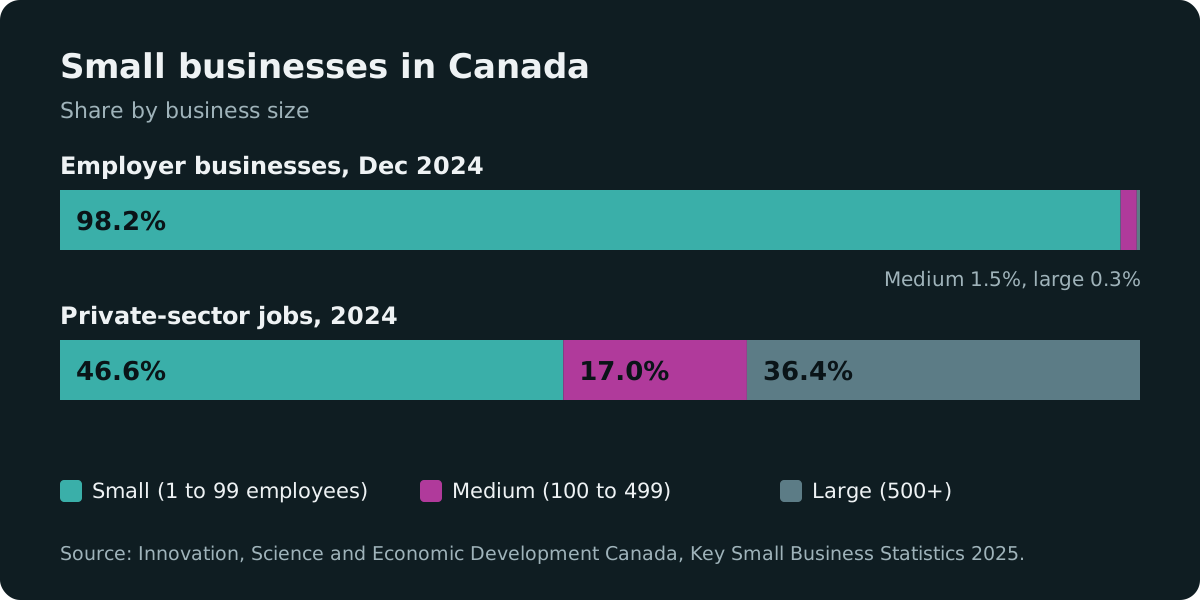
Small businesses are not a side note in the Canadian economy. According to Innovation, Science and Economic Development Canada's Key Small Business Statistics 2025, small businesses (1 to 99 employees) made up 98.2%, or 1.08 million, of Canada's employer businesses as of December 2024. The same report says they employed 5.8 million people in 2024, or 46.6% of the private labour force.
Many of your customers search on their phones, often from the job site or the driveway, and even referrals tend to look you up before they call.
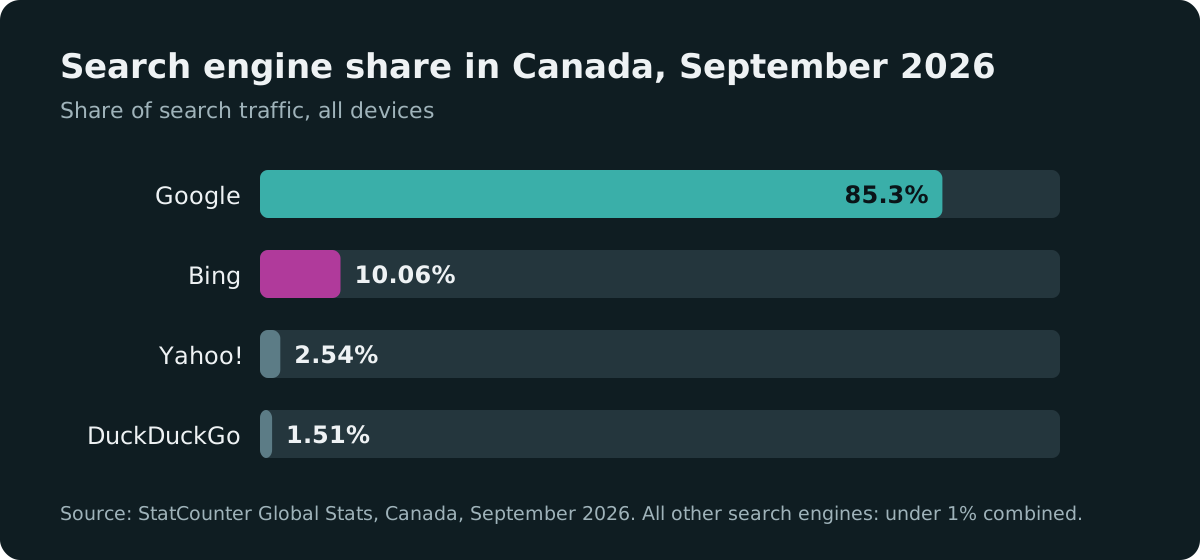
Where should your search effort go? StatCounter reported that Google's share of Canadian search traffic was 85.3% in September 2026, with Bing at 10.06%. Google deserves most of your attention, though Bing is worth a basic listing too. StatCounter measures observed usage rather than surveying the whole population.
How Google decides which local businesses to show
This is the part most owners want answered first. Google says its local results are mainly driven by three things:
- Relevance: how closely your profile matches what the customer wants. You influence this with correct categories, complete services, accurate hours and a clear description.
- Distance: how far you are from the searcher or the place they named. You set your location and service area accurately, but you cannot optimize away where the customer happens to be standing.
- Prominence: how well known and trusted you appear. Genuine reviews, positive ratings, relevant mentions and strong website visibility all feed into this.
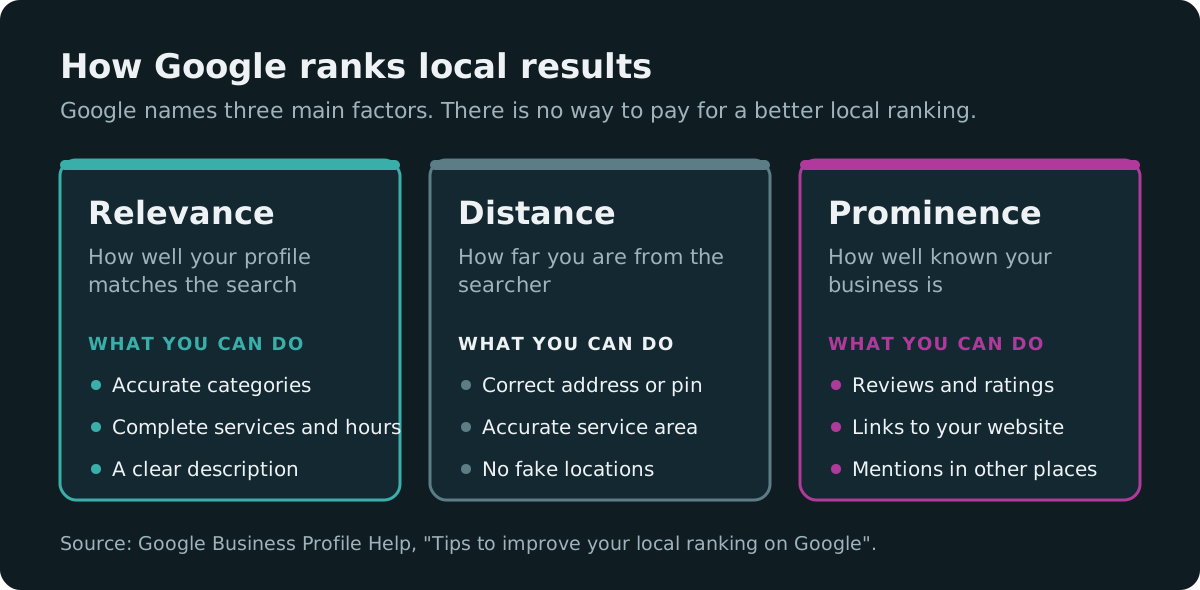
Here is the honest part. Google explicitly says there is no way to request or pay for better local ranking. More reviews and good ratings can support prominence, but no single action guarantees placement. Anyone claiming a special relationship with Google is telling a story.
Google Business Profile rules that trip up trades
Your profile is one of the highest-value things you control. A few rules matter a lot for service businesses:
- Use your real business name. Stuffing it with cities, services or "24 Hour" can get you suspended.
- If you travel to customers and have no storefront, use a service-area profile and hide your address. Google uses a home-based plumber as its own example of this.
- No PO boxes, rented mailboxes or unstaffed virtual offices. These are not eligible locations.
- Normally you get one profile for your central location. Extra profiles need genuine, separately staffed locations. Google says the overall service area should generally stay within about two hours' driving time.
- Choose categories that describe what you are, not every service you have ever done. Use the smallest set of specific categories that fits your core business.
If keeping your profile compliant and complete feels like a chore, that is a sensible thing to hand off. Our Google Business Profile management work exists for exactly this.
What you can do yourself, and what is worth handing off
You do not need an agency to start. Plenty of early steps are well within reach of a busy owner.
You can usually do these yourself:
- Claim, verify and fully complete your Google Business Profile.
- Add real photos of your crews and finished jobs.
- Ask every customer for an honest review, then reply to them.
- Write plain descriptions of your main services in your own words.
- Keep your name, phone and hours consistent across the places customers find you.
These are harder to do well alone:
- Diagnosing why pages are not indexed or why speed is poor.
- Planning a service and location structure that does not trip over Google's rules.
- Adding structured data that matches what is on the page.
- Building a content plan tied to the services that actually make you money.
There is no shame in either path. The question is where your hours are best spent. Google's own guidance on hiring an SEO suggests you commit to implementing changes, interview candidates, check references and ask whether they follow Google Search Essentials. That is a good filter whether you hire us or anyone else.
A strategy-first plan you can follow
Here is the order we work in, because sequence matters.

- Define your priorities. List the services with the best margins and close rates, and the cities your crews can serve profitably. Build a short service-by-market matrix, not a giant keyword list.
- Establish a baseline. Record your current enquiries, booked jobs, reviews and indexed pages. Confirm you own your domain, website, Analytics, Search Console and Business Profile. If you do not own these, fix that first.
- Fix local foundations. Verify your profile, clear out duplicate or ineligible listings, and make your core details consistent across important Canadian directories and trade associations.
- Build the website around customer intent. Create one strong page for each priority service and each genuinely different market. Use the words customers actually use.
- Add evidence and trust. Show licences where they apply, insurance, warranties, your process, real job photos and named service areas. You are asking someone to let you into their home. Reduce that risk.
- Develop demand-led content. Mine your sales calls, estimates and Search Console queries for topics worth covering. Write to support a buying decision, not to hit an arbitrary weekly quota.
- Earn reputation and authority. Ask every eligible customer for an honest review, and pursue legitimate supplier, association and local-media mentions.
- Measure and improve monthly. Compare leads, lead quality and booked work by service and market. Improve weak pages before you pump out more content.
Your website and content priorities
A small service site does not need hundreds of pages. It needs the right ones.
A minimum page set looks like this:
- A homepage explaining your core service, real operating area and reason to choose you.
- One substantive page for each important service.
- Location pages only for markets you genuinely serve.
- An about page showing real people and qualifications.
- A contact or booking page with a local number, hours and a short form.
- Case studies showing the problem, location, solution and outcome.
High-value topics for home services include Canadian or city-specific price ranges with update dates, repair versus replacement, safe troubleshooting steps, what happens on an emergency call, and seasonal maintenance tied to Canadian climate. Verify any permit, licence or rebate detail against the responsible local authority before you publish it.
Watch the location-page boundary. A useful city page stands on its own, with services actually available there, local projects and a clear way to book. Google's spam policies treat near-identical city pages that just funnel visitors elsewhere as doorway abuse.
Google recommends original, complete content that shows first-hand expertise and clear authorship. It warns against mass-produced summaries, arbitrary word counts and superficial date changes. For contractors, the main risk is generating generic service-plus-city pages instead of documenting genuine local experience. That is why our SEO work starts with a topic plan built around the services and areas a business really covers.
Technical essentials, without the jargon
Technical SEO sounds intimidating. At the core, it is about keeping the plumbing clear so Google can do its job. Google's SEO starter guide covers the fundamentals, and the checklist below reflects its advice.
- Make sure important pages load successfully and are not accidentally blocked or set to noindex.
- Give every priority page a unique, descriptive title and main heading.
- Use clear internal links so people and crawlers can reach every service and location page.
- Design for mobile: readable text, tap-to-call buttons, short forms and no intrusive pop-ups.
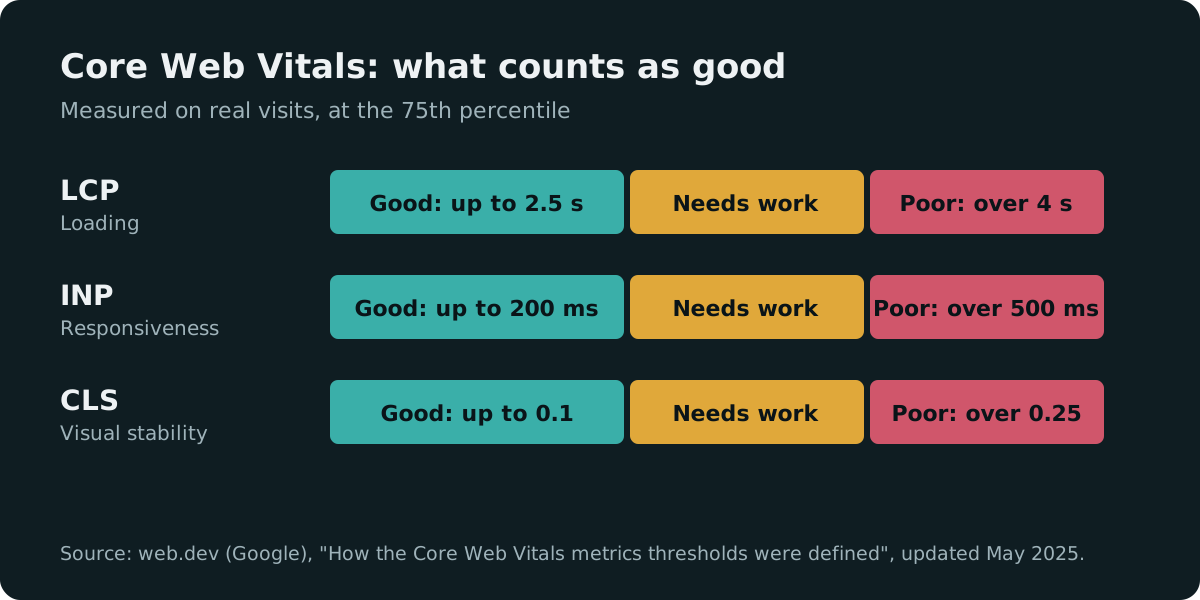
- Use HTTPS and work on real-world speed. Google's recommended Core Web Vitals thresholds are LCP within 2.5 seconds, INP below 200 milliseconds and CLS below 0.1. Good scores help page experience but do not guarantee rankings.
- Add accurate structured data and keep it consistent with what visitors can see. Validate it with Google's Rich Results Test.
Keep structured data word for word with the visible page, because Google expects the two to match. If this is not how you want to spend your evenings, our technical SEO and local SEO work covers it.
Reviews: a real opportunity with real rules
Google says review quantity and rating contribute to local prominence, and helpful replies help you stand out. The method matters.

Do:
- Generate Google's official review link or QR code and share it after a job.
- Ask for an honest review from every customer, not only the ones you expect to be happy.
- Respond professionally to good and bad reviews.
Do not:
- Buy reviews or offer discounts for them.
- Gate reviews by screening for happy customers first.
- Ask staff or family to pose as customers.
A practical setup combines a short review link, QR cards to hand out after a job and a ready-to-send thank-you email for finished projects. One more Canadian note: the Competition Bureau says employees reviewing their employer or competitors must clearly disclose that connection, and false or misleading representations can breach the Competition Act.
How long does SEO take?
This is the question that separates honest advice from sales talk. Google's hiring guidance says SEO benefits typically take four months to one year after changes begin. A 6 to 12 month planning horizon for meaningful results is reasonable for a small service business. It is a typical range, not a promise. Your existing authority, competition, technical condition, market size and review profile can shorten or stretch it.
Some changes show up in hours. Others take months, and Google recommends waiting at least a few weeks before judging many of them. Early signs can include correct indexing, more impressions and broader non-branded queries. Judge the business case on qualified enquiries and booked revenue, not vanity numbers.
Common mistakes and red flags
A few patterns reliably waste money. If a provider does these, walk away.
- Guaranteed first place, guaranteed map-pack placement or a claimed special relationship with Google.
- Selling paid ads as if they were organic SEO.
- Refusing to explain changes, share account access or confirm who owns your website, domain and profiles.
- Keyword-stuffed profile names, fake locations or duplicate listings.
- Bought reviews, review gating or submissions to thousands of directories.
- Hundreds of AI-generated pages with no original local evidence.
- Reporting only rankings, with no link to qualified leads or revenue.
Google itself says no one can guarantee a number-one ranking and advises you to reject guaranteed first-place claims and secretive providers. That is not our opinion. That is from the people who run the search engine.
A quick checklist to start this week
- Claim and fully complete your Google Business Profile, with real photos.
- Confirm you own your domain, website, Analytics, Search Console and profile.
- List your five priority services and two real markets.
- Make sure your name, phone and hours match everywhere.
- Set up an honest review request for every finished job.
- Check that your main service pages load fast on a phone and have a clear way to call or book.
Work through that list and you will have the foundations most local searches depend on. If you reach the point where you would rather hand the planning and the technical work to a founder-led team that explains what it does each month, you can learn more about our SEO services or book a call. Either way, the goal is the same: visibility and enquiries you own.