

If you own a home service business in Canada, you have probably typed your own trade and city into Google, stared at the map, and wondered why the three businesses in that little box are not you. Maybe a competitor two neighbourhoods over sits right at the top while your phone stays quiet. The good news is that Google is not flipping a coin. It is following a fairly plain set of rules, and once you understand those rules, you can decide what to do next.
This article explains how Google actually decides which businesses to show in local results, in plain language, with Canadian examples from the trades.
Who this article is for (and who it is not for)
This is written for owners and managers of Canadian home service businesses with roughly 1 to 50 staff. Think plumbing, electrical, roofing, pest control, cleaning, moving, junk removal, tree and lawn care, water damage restoration, appliance repair and window installation. If you serve customers at their homes across cities like Ottawa, Toronto, Vancouver, Calgary or Edmonton, this is for you.
This is probably not for you if:
- You run an online-only business with no in-person customer contact. Google generally expects a Business Profile to belong to a business that makes in-person contact with customers, so check the current eligibility rules before you rely on one.
- You are a large national brand with a dedicated in-house SEO team.
- You want a trick to leap to the top this week. That is not how any of this works, and anyone who tells you otherwise is selling you something.
Still here? Good. Let us get into it.
The short answer: relevance, distance and prominence
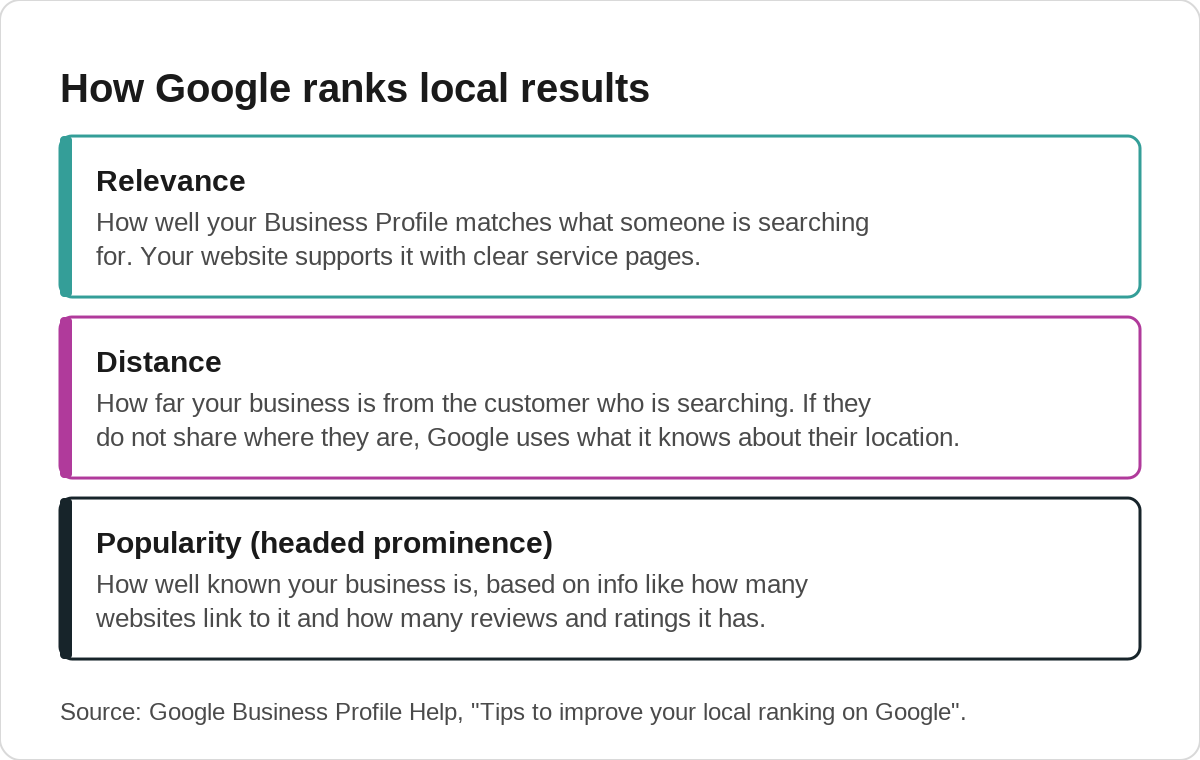
Google uses three main factors to rank local results: relevance, distance and prominence. That is straight from how Google ranks local results. There is no fixed number-one spot you can buy, and Google's guidance indicates you cannot pay for a better organic local rank.
Here is what each factor means in everyday terms:
- Relevance: How well your business profile and website match what the person searched for.
- Distance: How close you are to the searcher or to the place they named in their search.
- Prominence: How well known your business appears to be, based on things like reviews, links and mentions around the web.
The results you see can change based on the exact words searched, where the searcher is standing, the time of day, and which businesses are open. So the first thing to accept is that there is no single "rank" to chase. A roofing company might show up strongly three blocks from its shop and vanish across town. That is distance doing its job, not a failure on your part.
Relevance: does Google understand what you do?
Relevance is about matching. When someone searches "drain cleaning near me," Google checks which businesses clearly offer drain cleaning. You help it understand by keeping your profile complete and accurate.

A few things that feed relevance:
- Your primary category, chosen to describe your main business as specifically as possible.
- A short list of additional categories for real, related services.
- The actual services you list on your profile.
- Clear pages on your website for your priority services, such as furnace repair, sump pump installation or shingle replacement.
Categories are not keyword tags. A sound approach, consistent with Google's guidelines for representing your business, is to pick the most specific category that fits and only add a few relevant extras. Stuffing in categories you do not really serve does not help, and it muddies the picture for the people who do call you.
Your business name is not a keyword field
It is tempting to rename your profile something like "City Fast Plumbing and Drain Repair" because keyword-heavy names often correlate with visibility. Resist it. The safe approach is to use your profile's genuine, real-world name, the one on your truck, your invoices and your signage. Adding cities or services just to rank is widely understood to be against Google's rules and can put your profile at risk. Use your real name and build relevance the honest way.
Distance: the factor you cannot control (and should stop fighting)
Distance measures how far you are from the searcher. If nobody names a location, Google estimates where the searcher is. This is the factor owners most often misunderstand.

You cannot move your shop closer to every customer. For a service-area business, a sensible practice is to keep your service area within reasonable driving time of your base rather than listing every city you can reach. Listing every surrounding city does not make you locally established in all of them. Independent testing shows that Maps visibility tends to centre on your verified physical address, even when the address is hidden.
What this means in practice:
- A moving company based in east Calgary will likely show strongly near its base and weaker on the far west side.
- One rank check from your office tells you almost nothing. You need to measure visibility from several neighbourhoods to see the real picture.
- Chasing an entire metro area for every service is often a waste of effort. Picking the services and areas you can genuinely serve profitably is a smarter plan.
The service-area setting is still worth filling in correctly, because it tells customers where you work, as covered in our Google Business Profile checklist for service-area businesses. Just do not expect it to carry your ranking.
Prominence: the part you can build over time
Prominence is how well known your business appears to be. Google says this draws on links from other websites, reviews, ratings and other information it finds across the web. You cannot flip a switch for this one. You build it.
Things that contribute to prominence:
- Genuine customer reviews and ratings on your profile.
- Mentions and links from suppliers, trade associations, chambers of commerce and local community groups.
- Accurate listings in credible Canadian directories.
- Local news or sponsorship coverage.
Google compiles its understanding of your business from more than just what you type into your profile. It pulls from your website, third-party listings, licensed data sets and user contributions. That is why keeping your name, address and phone number consistent everywhere matters. If three directories list three different phone numbers for your electrical company, you are making Google work harder to trust you.
Reviews: valuable, but there are rules
Google confirms that review count and positive ratings can help local ranking. Reviews also help customers choose you, which is arguably the bigger win. You are allowed to ask honest customers for reviews using your official link or QR code.

Practices that are widely understood to breach Google's review policies include:
- Paying for reviews or offering discounts in exchange for them.
- Asking only your happy customers (review gating).
- Asking for a negative review to be removed in exchange for something.
Treat Google's current review policies as the source of truth before you build your process around any of these.
In Canada, there is an extra layer worth checking. Fake reviews that pose as independent customer opinions can raise misleading-advertising concerns, and there is guidance that employees reviewing their own employer should disclose that relationship. Review the Competition Bureau's current guidance so your review process stays onside.
A steady, honest review process is the safe and effective path. As we did for one of our clients recently, we set up a short review link on their own website, QR cards to hand out after a job and a ready-to-send thank-you email for finished projects.
It is not one ranking, it is several surfaces
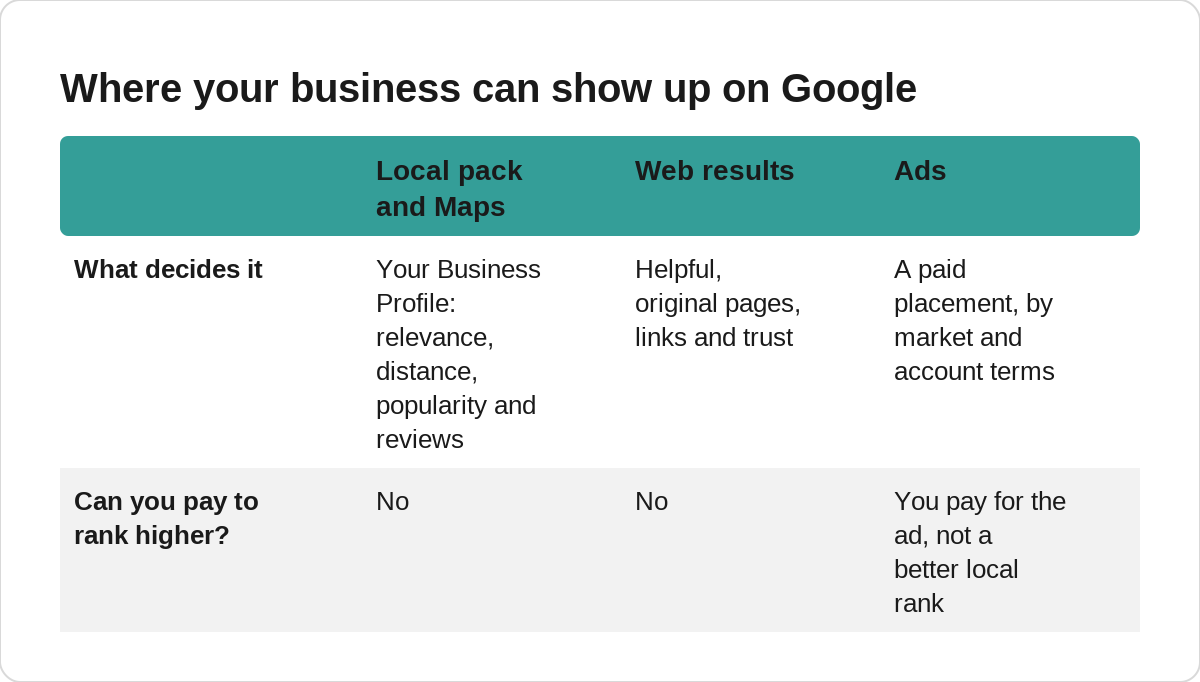
When an owner says "we do not show up," they usually mean the map box. But Google ranks a few different surfaces, and they work differently:
- The local pack and Google Maps lean heavily on your Business Profile, relevance, distance, prominence and reviews.
- Regular web results are ranked by Google's general systems, which judge individual pages for usefulness, originality, links and trust. A strong profile does not remove the need for genuinely helpful website pages.
- Ads, including Local Services Ads, are paid placements. We should be clear: the current Canadian availability, eligible categories and pricing of Local Services Ads vary by market and account terms, so there is no single Canada-wide status to quote. Paid placement is not local SEO, and you still cannot buy a better organic local rank.
- AI Overviews may appear for some searches depending on where and how a search runs, so check the current availability for your market. Google says the same search fundamentals apply and that accurate profile and website information support visibility there. There is no separate "AI SEO" product that overrides the basics.
A strategy-first priority order
If you want to work on this yourself, do it in an order that respects cause and effect. Later steps barely matter if the earlier ones are broken.
- Decide what to target. Pick the services and areas that are actually worth your time and that you can serve well. Do not chase every keyword in the metro area.
- Claim and verify your profile. Verification tells Google you are authorized to represent the business and makes the profile more likely to appear.
- Fix the fundamentals. Confirm your name, categories, address, map pin, phone, hours and service list are correct and consistent.
- Build one useful page per important service. A real page for furnace repair, another for ductless heat pump installation, and so on. Vague, thin pages do not earn trust.
- Add real local evidence. Project photos, neighbourhood knowledge, permit notes, climate considerations for your region and honest service limits all help. Avoid copy-paste city pages that just swap a town name.
- Run a steady review process that follows Google's rules and Canadian law.
- Build local prominence through trade groups, suppliers, community partners and credible directories.
- Measure and adjust monthly. Tie your effort to booked enquiries and revenue, not to a single rank check.
If you want a broader starting point beyond local, our plain-language guide to SEO for Canadian small businesses walks through the wider picture.
Common mistakes we see in the trades
- Stuffing keywords into the business name. Against the rules, and risky.
- Adding 20 cities to the service area and expecting to rank in all of them. The setting informs customers; it does not move your ranking centre.
- Claiming 24-hour availability when you are not. Being open at search time can help visibility, but false hours are a policy problem and a customer-trust problem.
- Treating weekly profile posts as the main strategy. Posts can help you communicate, but they are not a reliable way to move your ranking.
- Buying reviews or gating them. Google is increasing enforcement against fake engagement, and profiles can lose reviews or be blocked from receiving new ones.
- Judging results too soon. Ranking changes can take time to settle, so give your work room before you judge it. Meaningful SEO results build over months, not days, especially in competitive markets.
What to do versus what not to do
Do:
- Use your real business name and specific categories.
- Keep your details consistent across your website and listings.
- Publish genuinely useful service pages with first-hand expertise.
- Ask every honest customer for a neutral review.
Do not:
- Promise yourself a guaranteed number-one spot. Google says no one can guarantee that.
- Create a fake storefront to show a visible address you do not staff.
- Assume ads lift your organic Maps rank. They do not.
- Rely on one rank check to decide whether your visibility is working.
A short next step
Here is a quick checklist to run this week:
- Is your profile verified and is your name your real-world name?
- Is your primary category the most specific fit?
- Are your address or service area, pin, phone and hours correct and consistent?
- Does each priority service have its own useful page?
- Do you have a simple, honest review process running?
- Are you measuring enquiries, not just rank?
Local search rewards businesses that accurately describe what they do, target sensible services and areas, publish real local expertise, and earn honest validation. It is an evidence-building process, not a pile of recurring busywork.
If you would rather have a documented plan and a team supervised by the owners handle the local SEO and Google Business Profile work with you, that is exactly what we do, on month-to-month terms and with no ranking promises. Book a call and we will take a look at where you stand.