

When customers search with AI, they ask longer questions and often get an answer without clicking a single website. This raises a fair question for any local business owner: should you keep doing search engine optimization, or switch to something called GEO? The short answer is that GEO does not replace SEO. For a Canadian local business, GEO is an extra layer on top of your SEO foundation. SEO helps you rank in Google Search and Maps. GEO, which stands for generative engine optimization, helps your facts, expertise and reputation get picked up, summarized or recommended by AI systems. You need both, and the work overlaps more than the two acronyms suggest.
Who this article is for, and who it is not for
This article is written for owners and managers of Canadian local businesses with roughly 1 to 50 staff. That includes home services such as plumbing, electrical, roofing and cleaning, health and wellness practices such as physiotherapy and dental clinics, professional services such as accounting and law firms, and personal care and fitness businesses such as hair salons, spas and gyms.

It will help you if you want a clear explanation of how AI search changes local visibility, and what you can actually do about it.
This article is not for you if you are looking for a quick trick to appear in ChatGPT answers overnight, or a promise of guaranteed placement in AI results. No one can honestly offer that, and we will not pretend otherwise. It is also not a technical SEO manual. It is a plain-language overview to help you decide what to do next.
SEO and GEO, defined in plain terms
These two terms get used loosely, so here is how we think about them day to day.
- SEO (search engine optimization): improving your website and Google Business Profile so your business appears in organic results, Google Maps and local packs for relevant searches. The outcome you care about is rankings, map visibility, clicks, calls, direction requests and enquiries.
- GEO (generative engine optimization): improving how clearly and credibly your business and expertise are represented, so AI systems can retrieve, mention, cite or recommend you in an answer. The outcome is mentions and citations inside generated answers, sometimes without a website visit.
The most useful way to read this is simple. GEO extends SEO into AI-generated answers. It does not justify abandoning local SEO, technical SEO, useful content or reputation work.
Google is clear on this point. Its documentation says that generative features use the same ranking and quality systems as regular Search, and that there are no additional technical requirements or special optimizations needed to appear in AI Overviews or AI Mode. You can read this directly on Google on AI features and your website.
Why more Canadians searching with AI matters to you
AI-assisted search is growing in Canada. Reporting of this kind suggests many of those users treat AI tools as a search engine and that relatively few always verify AI information against another source, though the exact proportions depend on how the question is asked.
The practical lesson is cause and effect. If a prospect asks an AI tool about services like yours, your business may be chosen, ignored or described inaccurately before that person ever reaches your website. That makes it worth caring about how AI systems see you.
At the same time, regular search is not going anywhere. Google remains the dominant search engine for most Canadian internet users, so Google Search, Maps and your Business Profile remain the first priority. AI search is an addition to that work, not a substitute for it.
What actually changes when people search with AI
Queries get longer and more detailed
Reports on early AI Mode use suggest that people tend to ask noticeably longer questions than in traditional search, and that AI Mode can break a single prompt into several related searches to build a combined answer.
A regular search might be short, such as "emergency plumber Ottawa." An AI-style prompt might stack several conditions into one question: which plumber handles frozen pipes tonight, serves older homes, has strong recent reviews, and explains emergency-call pricing clearly.
What this means for your content: a page cannot just repeat a service keyword. It needs to make verifiable facts easy to find: exact services, service areas, availability, qualifications, your process, typical timelines, what affects price, and the limits of what you do.
Visibility is no longer just a number on a list
With AI answers, "we rank third" is no longer the full picture. An AI answer may:
- name your business without linking to it,
- cite one of your pages, an article, a video or a directory,
- use your business as evidence without recommending it,
- recommend several other providers in a comparison,
- answer the question fully without sending anyone to a website.
So visibility now includes whether you are mentioned, described accurately, and cited for the questions your customers ask. Being cited is not the same as being recommended, and it is worth keeping that distinction clear.
Fewer searches lead to a website click
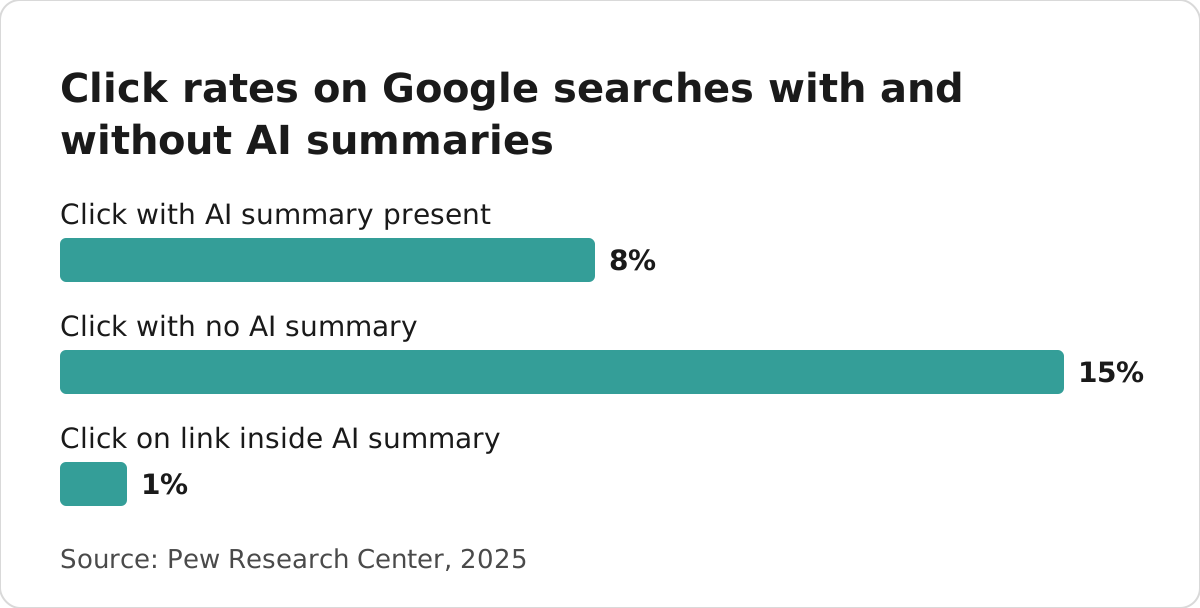
Research from outside Canada points in the same direction. A Pew Research Center analysis of 68,879 Google searches in March 2025 found that users clicked a conventional result after 8% of searches that showed an AI summary, versus 15% without one, and that a link inside the AI summary was clicked on just 1% of visits.
That is a U.S. study on general searches, not a Canadian local-business study, so treat it as a direction rather than a local number. The takeaway for planning is to stop judging success only by raw organic traffic, and to look at visibility plus qualified enquiries together.
What does not change
This is the part many owners miss. The fundamentals that help you rank also help you appear in AI answers.

Your Google Business Profile is still the foundation
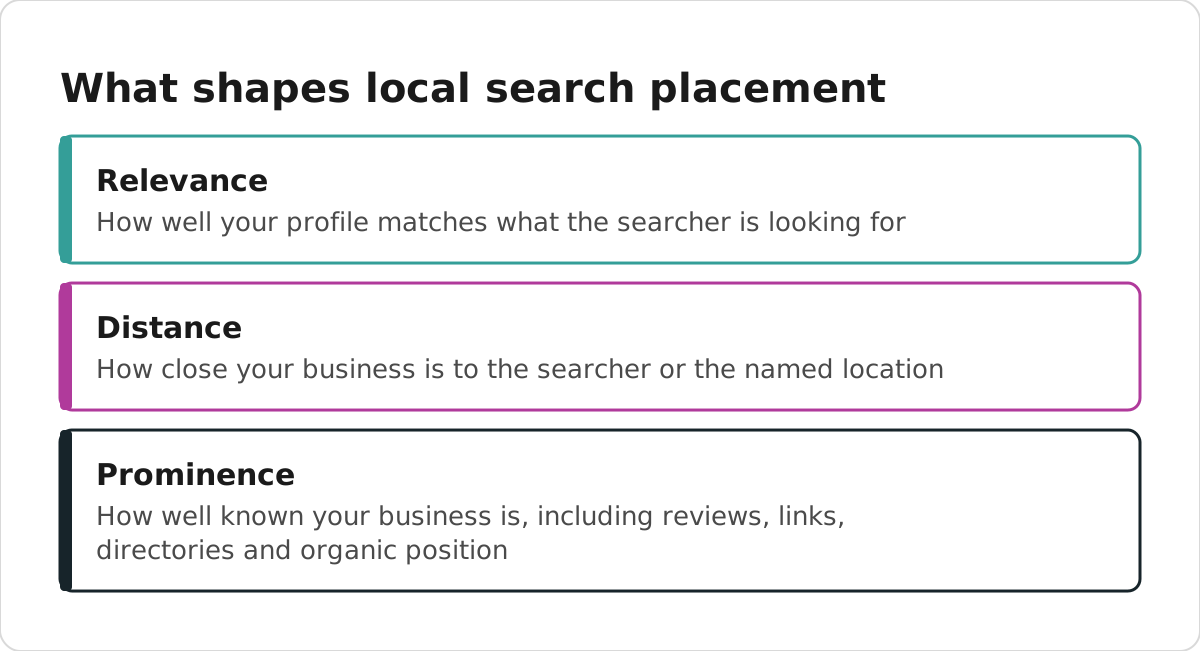
Google continues to base local results on a combination of factors, and three are often described as central:
- Relevance: how well your profile matches the search.
- Distance: how close you are to the searcher or the named location.
- Prominence: how well known your business is, including reviews, links, directories and your organic search position.
The priority fields have not changed. Keep your business name, address or service area and phone correct. Choose the most accurate primary category, add relevant services, keep hours current, add real photos, and reply to genuine reviews. Generally, local placement is earned through relevance, distance and prominence rather than bought. If you want a step-by-step approach, our Google Business Profile checklist for service-area businesses walks through it, and we explain the ongoing work on our Google Business Profile management page.
Regular website SEO is still the retrieval base
Google's guidance says generative features are grounded in its Search index. That means a page has to be crawlable, indexed and eligible for a search snippet before it can be pulled into an AI answer. Strong technical structure, fast pages and original, people-first content support both regular and AI visibility.
You do not need special AI markup
Available guidance suggests that extra files such as llms.txt are not a factor in your Google visibility, that no special schema type is needed for generative search, and that you do not need to split content into artificial "AI-friendly chunks" or build a separate page for every prompt variation. Structured data still helps with regular rich results. Mass-producing pages to game AI answers can run into scaled-content-abuse policies.
Be skeptical of anyone selling a "GEO package" built on special files or AI schema. By the available guidance, those shortcuts are not required. The real work is the same fundamentals done well.
What to do, and what not to do
Do this:
- Fix your website basics so pages are crawlable, indexed and fast.
- Keep your Google Business Profile accurate and complete.
- Build pages around real customer decisions, not a keyword count.
- Publish local, first-hand facts: price drivers, timelines, what happens at a first visit, and when your service is not the right fit.
- Earn genuine reviews, directory listings and professional mentions.
- Keep your business facts consistent everywhere they appear.
Do not do this:
- Do not assume "SEO is dead." It is the base layer for AI visibility.
- Do not buy fabricated mentions or mass-submit inconsistent listings.
- Do not treat more reviews as an automatic ranking boost.
- Do not expect one tool to be the single best choice for every business. Each platform has trade-offs, and the right fit depends on your services and customers.
Content that AI systems and customers both trust
Generic, recycled content is easy for AI to find elsewhere. Your advantage is local, specific, first-hand information only you can provide. Useful material includes owner-reviewed price ranges and what changes them, actual timelines and scheduling limits, local permit or provincial-rule considerations, original photos and short videos, and honest notes on when your service is not appropriate. If you want a hand producing this kind of material, our content marketing services can help.

Structure matters for readers. Use a descriptive heading, then a direct answer, then the explanation and evidence. Mix examples across the work you do. A roofing company can explain what affects a replacement quote. An accounting firm can explain what to bring to a first meeting. A hair salon can explain how long a colour service usually takes. A physiotherapy clinic can explain what happens at an initial assessment. There is no required AI format and no ideal page length.
A note for regulated professions
If you are a health practice, lawyer, accountant, real estate professional, or a financial, mortgage or insurance intermediary, your College or regulator's advertising rules come first, before any GEO tactic. These rules differ by profession and by province, and they can be stricter than Google's policies, especially around testimonials, superlatives and comparative claims.
A qualified owner or professional should review factual, clinical, legal and regulatory claims before anything is published, including anything drafted with the help of AI. Responsibility stays with you, not with the tool. Do not place identifiable client or patient information into a public AI tool without proper consent and safeguards.
A short checklist to get started
- Confirm your website is crawlable, indexed and fast.
- Complete and verify your Google Business Profile, with the right primary category.
- Review your top services and build pages around the real questions prospects ask.
- Add local, owner-reviewed facts that generic content cannot supply.
- Earn genuine reviews within your profession's rules, plus a few relevant directory or association listings.
- Keep your name, address, phone, hours and services consistent everywhere.
- Track Maps, organic search, AI citations, referral traffic and real enquiries together.
- For regulated professions, apply your regulator's advertising rules before publishing anything.
A word on timing. Meaningful SEO results take patience. We plan on 6 to 12 months for meaningful SEO results as our own planning horizon, not a promise. Google's own Search Engine Optimization Starter Guide explains that changes take time to show.
If you are new to this and want the groundwork first, our plain-language guide to SEO for small businesses in Canada is a good place to start.
The honest conclusion is this: the advantage is not an isolated GEO product. It is a coherent, verifiable presence that search engines, AI systems and your future customers can all understand and trust. AI search work, which we approach as AI search optimization, is part of the same plan, which is why it lives inside our SEO service rather than as a separate add-on. If you would like help deciding what to focus on first, book a call and we can look at your situation together.