

If you have been burned by an agency that promised the top spot on Google and then quietly missed it, you are not imagining the problem. No honest SEO agency promises a specific ranking, because no one controls where Google places a result. Google itself says, "No one can guarantee a #1 ranking on Google," and advises businesses to reject anyone who claims they can. A fair commitment covers the work, the reporting and the plan. It does not cover a position on a page the agency does not own.
That is the short answer. The rest of this post explains why the promise is impossible, what an honest commitment looks like instead, and how to spot the warning signs before you sign anything.
Who this article is for and who it is not for
This article is for owners and managers of Canadian local businesses with 1 to 50 staff who are weighing whether to hire help with search. That includes:
- Home services such as plumbing, electrical, roofing, cleaning, lawn care and moving companies
- Health and wellness practices such as psychologists, physiotherapists, chiropractors, dentists and optometrists
- Professional services such as accountants, bookkeepers, lawyers, real estate agents and mortgage brokers
- Personal care and fitness such as hair salons, spas, gyms and yoga studios
It is most useful if you have been pitched a ranking guarantee and want to understand what you are really buying.
This article is not for you if you want a trick to force a #1 position, or if you are looking for someone to sell you leads. We do marketing work that helps a business win its own customers. If a guaranteed rank is the only thing you care about, this will be a frustrating read.
Why can't an SEO agency promise a ranking?
An SEO agency cannot promise a ranking because the agency does not control Google, the person searching, the competitors, the algorithm or the demand. It controls the strategy and the work. That is a real line, and it matters.
Here is what sits outside any agency's control:
- Google runs the results, not us. Google's automated systems weigh many signals across a huge number of pages. We can improve your site and profile, but we do not get to set the order.
- A "ranking" is not one fixed thing. What someone sees can change by time, location, language, device and their own activity. Two people in the same city can see different results for the same search.
- Competitors keep moving. Rankings are comparative. Your site can get better while a competitor gets better faster, earns more reviews or publishes stronger service pages. Google notes that a page can move down without being bad; other results may simply become better choices for that search.
- Google changes its systems. Google makes broad core updates several times a year and smaller changes all the time. Positions are not frozen.
Google's own help pages are the best place to check how any of this works. For hiring questions, read Google's guidance on hiring an SEO. It is updated regularly and says plainly that an SEO should give realistic estimates and cannot guarantee a first-place ranking.
What does Google actually say about ranking promises?
Google says no one can guarantee a #1 ranking and warns you to be careful with anyone who claims a special relationship or a priority submission to Google. On Google's guidance on hiring an SEO, Google states that no priority submission for Google exists, and that an SEO should provide realistic estimates rather than promises.
A few more points from Google's own documentation worth knowing:
- Even a page that meets Google's technical requirements and policies is not guaranteed to be crawled, indexed or shown, as Google Search Essentials states.
- Third-party SEO tools cannot see Google's internal ranking data, so their predictions may not happen.
- Google's hiring page does not set out a fixed timeline for results. Google's SEO Starter Guide notes that changes can take time to show, with some taking effect sooner than others, and suggests allowing time before judging an effect.
That last point is why we talk about timing the way we do. We plan on roughly 6 to 12 months for meaningful SEO results. That is our own planning assumption, not a promise, and actual timing depends on the starting state of your website and Business Profile, how fast changes get implemented, your competition, search demand and Google's own reassessment cycle.
How do local rankings work in Google Maps?
Local results in Google Maps are mainly based on relevance, distance and popularity, and none of those can be bought. According to Google's help page, Google decides which local businesses to show using relevance (how well your profile matches the search), distance (how far you are from where the person is searching) and popularity. Google explains that last part under the heading prominence, which means how well known a business is. Google says this is also based on information like how many websites link to your business and how many reviews you have, and that more reviews and positive ratings can help your business's local ranking.

Notice the problem with promising a Maps position: distance depends on where the customer is standing when they search. A physiotherapy clinic can rank well for someone two blocks away and not appear for someone across the city, in the same minute. Nobody controls that. Google's own guidance indicates there is no way to request or pay for a better local ranking.
We cover how all of this fits together in our guide on how Google decides which local businesses to show, so we will keep it short here.
What should an honest agency promise instead?
An honest agency promises the work, the deadlines, the reporting and the plan, because those are the things it can actually deliver. It does not promise Google's response to that work.

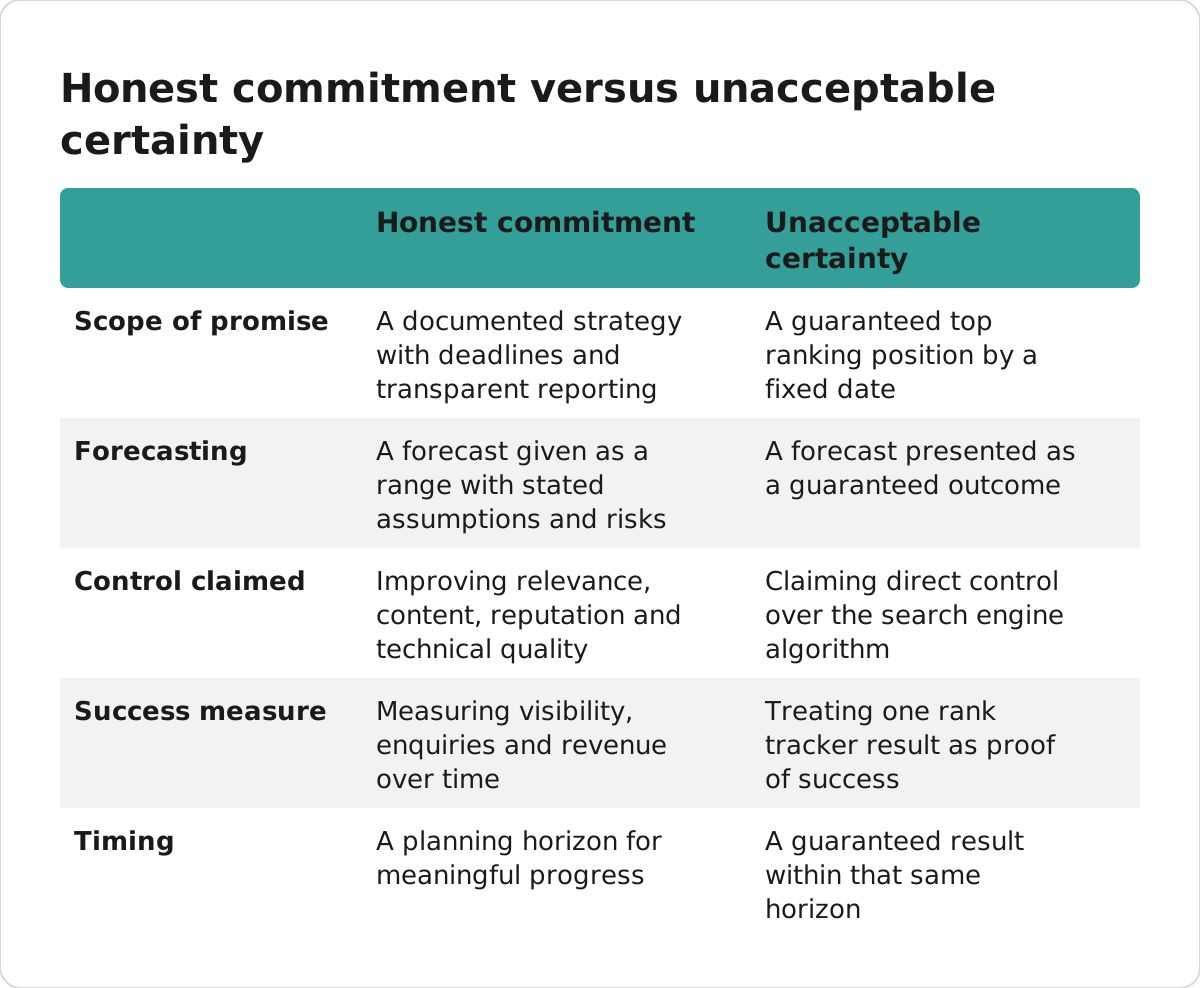
Here is a fair commitment laid out against the kind of certainty that should make you nervous.
| Honest commitment | Unacceptable certainty |
|---|---|
| A documented strategy, defined deliverables, deadlines and transparent reporting | "#1 on Google," "top three in Maps" or "page one in 90 days" |
| A forecast given as a range, with stated assumptions and risks | A forecast presented as a guaranteed outcome |
| Improving relevance, content, reputation and technical quality | Claiming direct control over Google's algorithm |
| Measuring visibility, enquiries and revenue over time | Treating one rank-tracker result as proof of success |
| Our 6 to 12 month planning horizon, with assumptions and risks | A guaranteed 6 or 12 month result |
The honest side of that table is auditable. You can check whether the strategy was documented, whether the deadlines were met and whether the reporting is real. The right side is a bet on something the agency cannot control.
What the work itself should cover
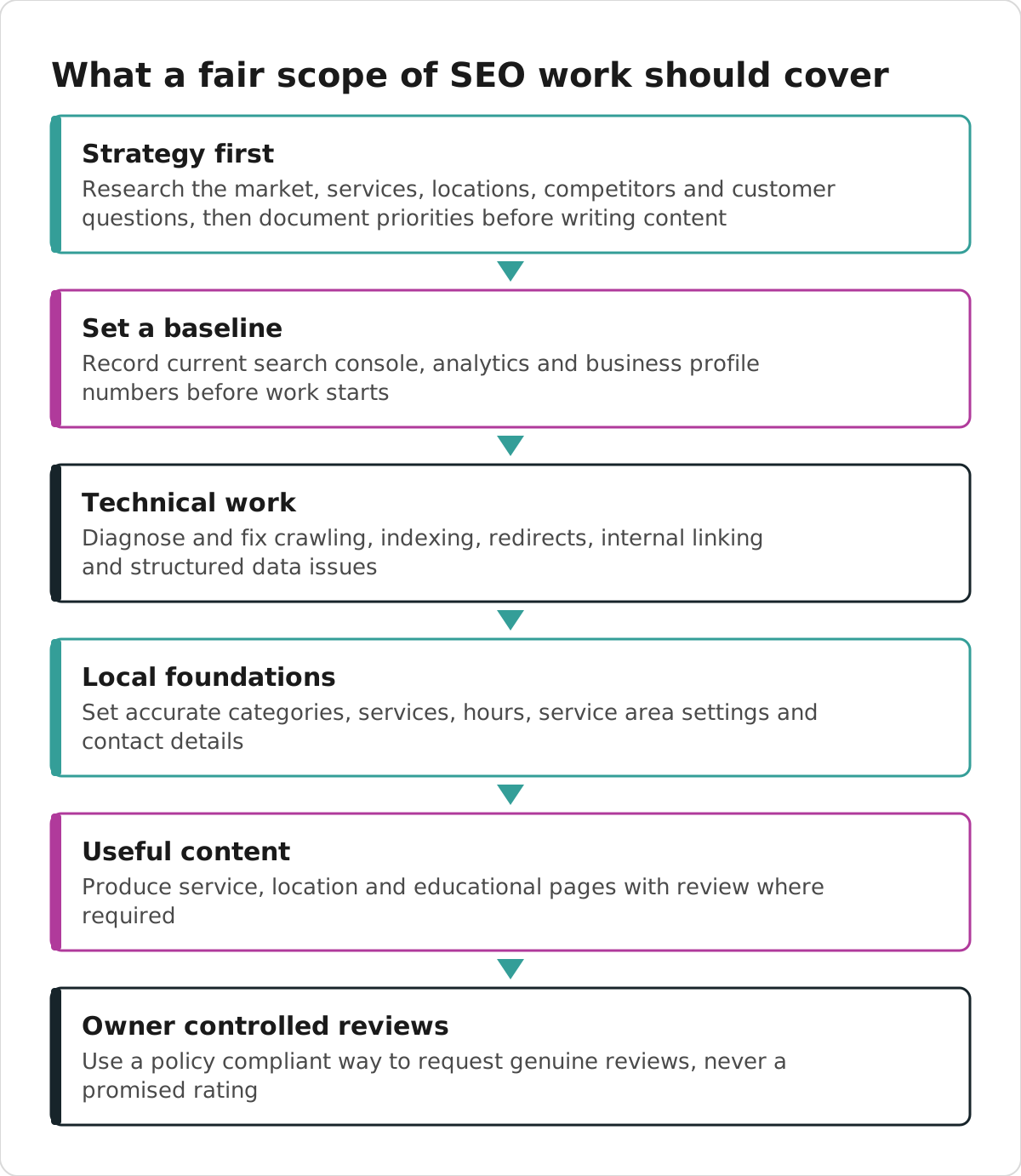
A fair scope for a Canadian local business usually includes:
- Strategy first. Research the market, services, locations, competitors and the questions real customers ask, then document priorities before any content is written.
- A baseline. Record current Search Console, Analytics and Business Profile numbers before work starts, so progress is measured against something.
- Technical work. Diagnose and fix crawling, indexing, redirects, internal linking and structured data issues in scope.
- Local foundations. Set accurate categories, services, hours, service-area settings and contact details on the profile.
- Useful content. Produce service, location and educational pages, with client and regulator review where it is required.
- A review process you own. A policy-compliant way to request genuine reviews, never a promised rating or review count.
On ownership, a good arrangement keeps the business as the owner or co-owner of its Business Profile, with the agency acting as a manager. If a provider wants to own your profile outright, that is a problem. This is part of why Business Profile management should always leave the keys in your hands.
What are the warning signs of a bad SEO pitch?
The clearest warning sign is a guarantee about Google's results rather than the agency's own work. A guaranteed #1, a guaranteed top three in Maps or page one by a fixed date all conflict with Google's own guidance.
Watch for these, drawn from Google's documentation:
- "We have a special relationship with Google" or "priority submission." Google says no priority submission exists.
- Charging for a "paid Google listing." Organic and Business Profile inclusion are free. No one sells a better organic or local rank.
- Secret methods or no change log. Google advises rejecting providers that will not explain what they do. You can bear the consequences of deceptive work done on your behalf.
- Bulk city pages with near-identical content. Google treats city pages that funnel users to one destination as doorway abuse.
- Hundreds of thin AI pages. Mass unoriginal content made mainly to manipulate rankings is scaled content abuse, whether or not AI wrote it.
- Paid links or forced link exchanges. Google classifies links made mainly to manipulate rankings as link spam.
- Fake or incentivized reviews. Google's policies prohibit paid, incentivized or fabricated reviews, and Google can act on reviews that break its policies.
- Reports showing only a handpicked keyword list. A flattering rank can depend on location, device or a phrase almost no one searches, and produce no enquiries.
If you want a structured way to vet a provider, we built an evaluation checklist for choosing an SEO company in Canada. It turns a lot of this into questions you can ask on a call.
Why does one ranking not tell the whole story?
One blue-link position does not capture every way a business can appear in Google Search. Google's AI features can run several related searches and show a wider set of supporting links, and the results can vary.
For a Canadian local business, that has a few effects:
- One keyword position does not tell the whole visibility story. It is better to watch website results, Maps, Business Profile interactions and AI-feature visibility together.
- AI Mode lets people ask longer, more detailed questions. Content that answers real questions about service, cost, suitability, process and location does more work than repeating an exact phrase.
- Google says there is no special optimization for its AI features and no secret schema. The same solid content and accurate Business Profile fundamentals apply, and inclusion is still not guaranteed. "Guaranteed AI citations" are just the newest version of guaranteed rankings.
What should you measure instead of a ranking?
You should measure the things that connect visibility to money: enquiries, their quality and the revenue they produce. A rank is a diagnostic, not the result you are paying for.

A practical set of measurements:
| Level | What to watch |
|---|---|
| Search visibility | Relevant non-brand impressions and clicks; query and page trends |
| Business Profile | Calls, website clicks, booking actions and direction requests |
| Conversion | Tracked calls, completed forms, appointment and quote requests |
| Lead quality | Service requested, location, fit, booked consultations and closed jobs |
| Commercial value | Cost per qualified enquiry, enquiry-to-customer rate, revenue |
| Delivery | Work completed against the roadmap, plus delays awaiting approval |
A dentist, an accounting firm, a hair salon and a cleaning company will each weigh these differently, but the pattern is the same: visibility feeds enquiries, enquiries feed customers, and that is the chain worth reporting on.
A note for regulated professions
If you are a regulated professional, your College or regulator's advertising rules come first, before any SEO idea. Health practices, lawyers, accountants, real estate agents, financial advisors, and mortgage and insurance brokers all work under rules about what marketing can say. In many cases these rules call for advertising that is truthful, accurate and verifiable, that does not create unrealistic expectations and does not guarantee successful outcomes, and they can hold the professional responsible for marketing done on their behalf. The exact wording varies by profession and regulator, so check your own College's current advertising standards. An honest agency asks which regulator governs you and builds review into the content process.
Your next step: a short checklist
Before you sign with any provider, run through this quick list:
- They commit to documented work, deadlines and reporting, not a ranking
- Any forecast is a range with stated assumptions, not a promise
- You keep ownership or co-ownership of your Business Profile
- Reporting shows enquiries and conversions, not just a chosen keyword list
- They explain their methods and share a change log
- Contracts let you cancel and remove their access cleanly
- They ask about your regulator if your profession has advertising rules
If a provider talks about the work, the plan and the reporting, and is honest that timing is a planning horizon rather than a promise, you are on safer ground. That is the standard we hold ourselves to with our own SEO work, where every engagement starts with an audit and a documented plan before any content is written. You can read more about Digital Moose and how we approach this.
If you would like a straight read on your situation, you can book a call with our team.